
How Do You Check Tire Tread Depth at Home?
Last Updated: October 29, 2026
Quick Summary
Check tire tread depth at home by measuring the shallowest groove on each tire with a tread depth gauge or a penny, and record the numbers. Measure the inner edge, center, and outer edge of all four tires, since the lowest reading is what matters.
A tire tread depth gauge gives exact numbers, while coin tests only give a rough pass or fail.
Insert a penny upside down into the shallowest groove; a visible Lincoln's head means 2/32 inch or less.
Press the gauge shoulders flat against the tread surface so the probe does not read deeper than the real groove.
Replace a tire when any groove reads 2/32 inch or less or tread is level with the wear bars.
A worn inner or outer edge on one side points to an alignment problem.
Table of Contents
What You Need to Check Tire Tread Depth at Home
Checking tire tread depth at home takes about ten minutes and costs almost nothing. A quick tread check is one of the cheapest safety inspections you can do. You need a few simple items, and most of them are already in your car or garage.
Here is your checklist:
A penny (for the classic penny test)
A quarter (for a slightly deeper check)
A tire tread depth gauge (a small, inexpensive tool for exact numbers)
A tire tread depth gauge is the most accurate tool of the bunch. Coin tests give you a rough pass or fail. A gauge gives you a number you can track over time. Keeping one in the glove box makes quick checks easy.
Step-by-Step: How to Check Tire Tread Depth on All Four Tires
Checking all four tires takes less time than brewing a pot of coffee. Follow these steps in order, and write down every reading.
Park on level ground and set the parking brake.
Find the wear bars. These are raised strips inside the tire grooves. If tread is level with them, the tire is done.
Pick three spots per tire: the inner edge, the center, and the outer edge.
Measure at each spot with your gauge or a coin.
Record the numbers for all four tires, and label them front left, front right, rear left, rear right.
Compare the readings across the tire and across the car.
Find the Shallowest Groove
The shallowest groove is the number that matters. A tire is only as safe as its lowest point of tread. If one spot reads 4/32 inch and the rest read 8/32 inch, treat the tire as a 4/32 tire. That low spot is where water will pool and where grip will fade first.
Measure Every Tire, Not Just the Front Two
A common mistake is checking only the front tires because they are easy to see. Rear tires wear too, and they often wear unevenly without any visible warning. On front-wheel-drive cars, the rear tires carry less weight and can hide problems for months. Measure all four, every time.
The Penny Test for Tires: What Lincoln's Head Tells You
The penny test for tires is the fastest way to spot a worn tire. Insert a penny upside down into a tread groove with Lincoln's head pointing down.

Here is how to do it correctly:
Insert the coin into the shallowest groove you can find.
Press it down until it touches the bottom of the groove.
Look straight at the tire, not at an angle.
The penny test is quick, but it has limits. It only tells you "replace" or "not yet." It cannot tell you whether you are at 3/32 or 6/32 inch. For that, you need a gauge.
Using a Tire Tread Depth Gauge for an Accurate Reading
A tire tread depth gauge gives you an exact number in 32nds of an inch or in millimeters, and that number is what lets you track wear over time instead of guessing pass or fail. Readers who prefer professional measurement can see the certified tire services offered locally.
Dad, how do I?
There are two common styles. A stick gauge (also called a plunger gauge) has a barrel that slides over a graduated rod; you push the rod into the groove and read where the barrel stops. A dial gauge has a spring-loaded probe and a needle that points to the depth on a round face, which is easier to read in low light.
How to read a tread depth gauge:
Push the probe fully into the groove until the shoulders touch the tread blocks.
Press the gauge shoulders flat against the tread surface, not at an angle.
Read the scale where the probe stops, in 32nds of an inch or millimeters.
What most guides miss is the shoulder press. If the gauge sits at an angle, the probe reads deeper than the real groove, and you get a false sense of safety. Keep the gauge square to the tire surface every time.
Converting 32nds to Millimeters
Most gauges sold in the United States read in 32nds of an inch, but some read in millimeters. Use this quick conversion so your records stay consistent:
32nds of an inch | Millimeters (approx.) |
2/32 | 1.6 mm |
3/32 | 2.4 mm |
4/32 | 3.2 mm |
5/32 | 4.0 mm |
6/32 | 4.8 mm |
8/32 | 6.4 mm |
10/32 | 7.9 mm |
Pick one unit and stick with it across all four tires. Mixing units is how drivers end up comparing a 4/32 reading on one tire to a 3.2 mm reading on another and thinking they match when they do not.
Why a Gauge Beats a Coin
A coin test is a screening tool: it tells you whether tread is above or below a fixed reference point. First, you can catch a tire at 5/32 inch and plan replacement before it drops to the 2/32 inch legal minimum. Second, you can compare the inner, center, and outer grooves on the same tire and spot a wear pattern a coin would miss. Third, you can log readings at each oil change and see how fast the tire is wearing, which helps you budget for replacement instead of being surprised by it.
Pro Tip Keep a cheap stick gauge in the glove box and a dial gauge in the garage. The glove-box gauge is for quick checks; the dial gauge is for the readings you record.
If your gauge readings are inconsistent from spot to spot, the tire may have cupping or flat-spotted tread, which is a condition to inspect rather than a measurement error. Note the pattern and check the section on uneven wear below.
Reading the Numbers: 2/32, 4/32, and 6/32 Inch Explained
Tread depth numbers tell you how much rubber is left between you and the road. Here is what each number means in plain terms:
Depth Reading | Condition | What It Means |
2/32 inch | Worn out | At the legal minimum; replace now |
3/32 inch | Marginal | Wet grip is fading fast |
4/32 inch | Caution | Time to plan replacement |
6/32 inch | Good | Healthy tread for wet roads |
8/32 inch or more | Like new | Full tread life ahead |
The 2/32 inch mark is the minimum tread depth under federal safety standards, and wear bars sit at that level. Many drivers choose to replace well before that point. Once a tire hits 4/32 inch, wet-weather traction drops, and stopping distances grow.
Uneven Tire Wear: What It Looks Like and What It Means
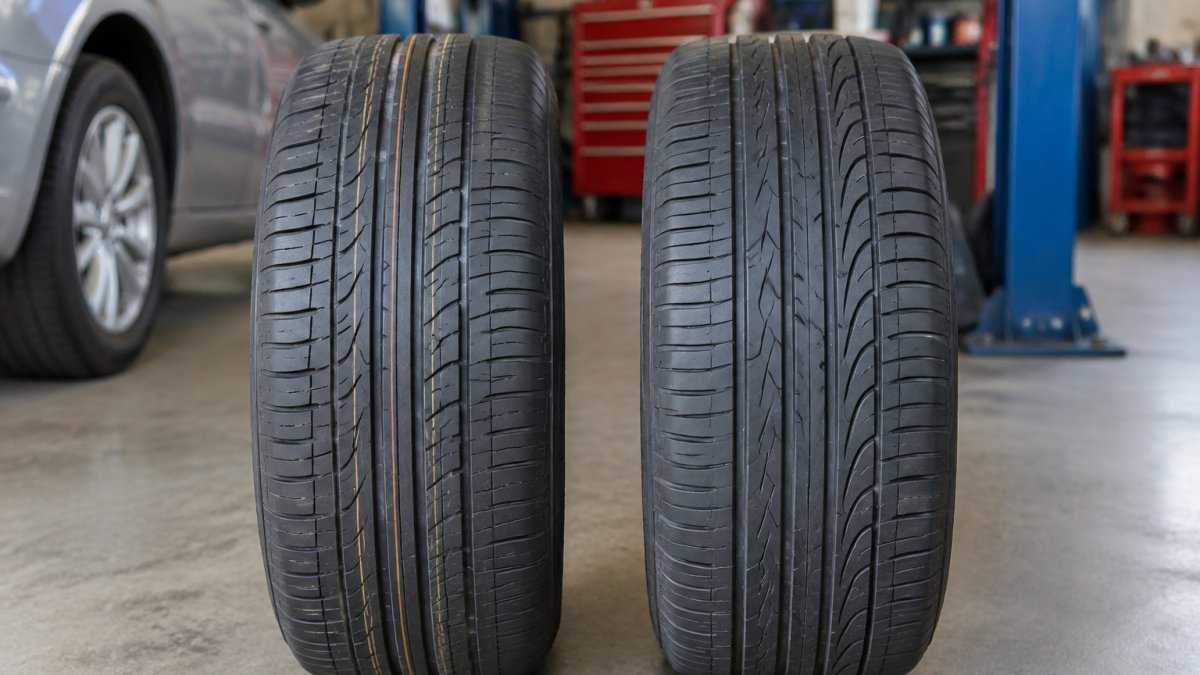
Uneven tire wear shows up as one edge worn smooth while the other edge looks fine. It can also show as a bald center strip or a series of cupped dips around the tire. Each pattern points to a different cause, and the pattern is the diagnostic clue, the tire is telling you what the suspension, alignment, or inflation is doing.
Reading the Wear Pattern
Worn inner or outer edge (one side only): alignment is off. Too much camber or toe on that corner drags the edge across the road. This is the most common pattern drivers notice, because the worn edge is visible when the wheel is turned.
Worn center strip: tires are overinflated. The center of the tread bulges out and carries more load than the shoulders, so it wears first. Check the door-jamb placard for the vehicle's recommended pressure, not the number molded on the tire sidewall, which is a maximum.
Worn both edges, center still deep: tires are underinflated. The sidewalls flex and the shoulders take the load. This pattern often comes with a soft, squishy ride and higher rolling resistance.
What the Pattern Tells You to Do
A single low reading on one tire is a replacement question. A pattern across the tire is a service question. The distinction matters because replacing a tire without fixing the cause means the new tire will wear the same way.
One edge worn: get an alignment check before or with the tire replacement.
Center worn: check and correct inflation, then re-measure in a few hundred miles.
Both edges worn: check inflation first; if pressure is correct, have the tire inspected for sidewall fatigue.
Watch Out Uneven wear is a symptom, not just a tire problem. If you replace the tire and skip the alignment or suspension check, the new tire will likely wear the same way, and you will pay for the same repair twice.
If you spot uneven wear, what causes uneven tire wear goes deeper into alignment, suspension, and inflation. The short version: measure all four tires, note the pattern, and treat the pattern as the reason to book an inspection rather than only a reason to buy rubber.
Check the Other Three Tires Before You Decide
Uneven wear on one tire is a reason to check the other three immediately. A worn inner edge on the front left often pairs with a matching pattern on the front right, because alignment and inflation problems usually affect an axle, not a single corner. Write down all four sets of readings side by side. If two tires on the same axle show the same pattern, the cause is almost certainly shared, alignment, inflation, or a suspension component, and the fix should address both tires.
When to Replace Tires Based on Your Measurements
Replace a tire when any groove reads 2/32 inch or less, when tread is level with the wear bars, or when you find cracks, bulges, or exposed cords. Replace in pairs at minimum, and ideally all four at once on all-wheel-drive vehicles.
Use your own numbers to decide:
4/32 inch or less: start shopping now
2/32 inch or less: replace before your next drive in rain
Uneven wear across one tire: get an alignment check
If your readings point toward replacement, when to get tire replacement and alignment walks through the signs and what service protects your safety and tire life.
Book a Free Tread and Tire Inspection
Measuring tread at home is a smart habit, but a professional inspection catches what a coin cannot. Innovation Auto Body Mechanics & Tires has served drivers since 2009, and our technicians hold I-CAR and ASE certifications.
As a family-owned shop, we pair dealership-quality results with fair, transparent pricing. Request a free estimate from Innovation Auto Body Mechanics & Tires and drive on tires you can trust. Our Tire & Alignment Services handle inspection and replacement.
Frequently Asked Questions
How often should I check my tire tread depth?
Check tire tread depth once a month and before any long highway trip. Tread wears gradually, so a monthly check catches changes early, especially if you drive on gravel, tow a trailer, or notice the tires starting to feel loose on wet roads. Pair the depth check with a pressure check, since low pressure speeds up tread wear. If a measurement drops noticeably in one month, have the tire inspected for alignment or suspension problems before it gets worse.
Is a 3/32-inch tread depth bad for tires?
Yes, 3/32 inch is close to the legal limit of 2/32 inch, and wet traction drops off sharply below 4/32 inch. At 3/32 inch, water has very little room to escape through the grooves, so hydroplaning risk rises and stopping distances on wet pavement get longer. Most tire manufacturers recommend replacing at 4/32 inch rather than waiting for 2/32 inch. Treat 3/32 inch as a signal to start shopping for new tires now, not later.
Where should you measure tire tread depth?
Measure in the shallowest groove you can find, and take readings at three points across the tread: the outer shoulder, the center, and the inner shoulder. Do this on all four tires, since front and rear tires wear at different rates. A tire tread depth gauge makes these three readings quick and repeatable. If one edge reads much lower than the other, that points to uneven tire wear from alignment or inflation issues rather than normal wear.
Can uneven tire wear mean there is a problem?
Yes. Wear on both outer edges usually means the tire has been run underinflated. Wear down the center points to overinflation. A single worn edge often signals an alignment problem, and cupped or scalloped spots can indicate worn shocks or suspension parts. Uneven tire wear shortens tire life and can hurt handling, so have the alignment and suspension checked before installing new tires, or the replacements will wear the same way.
Comments