.png)
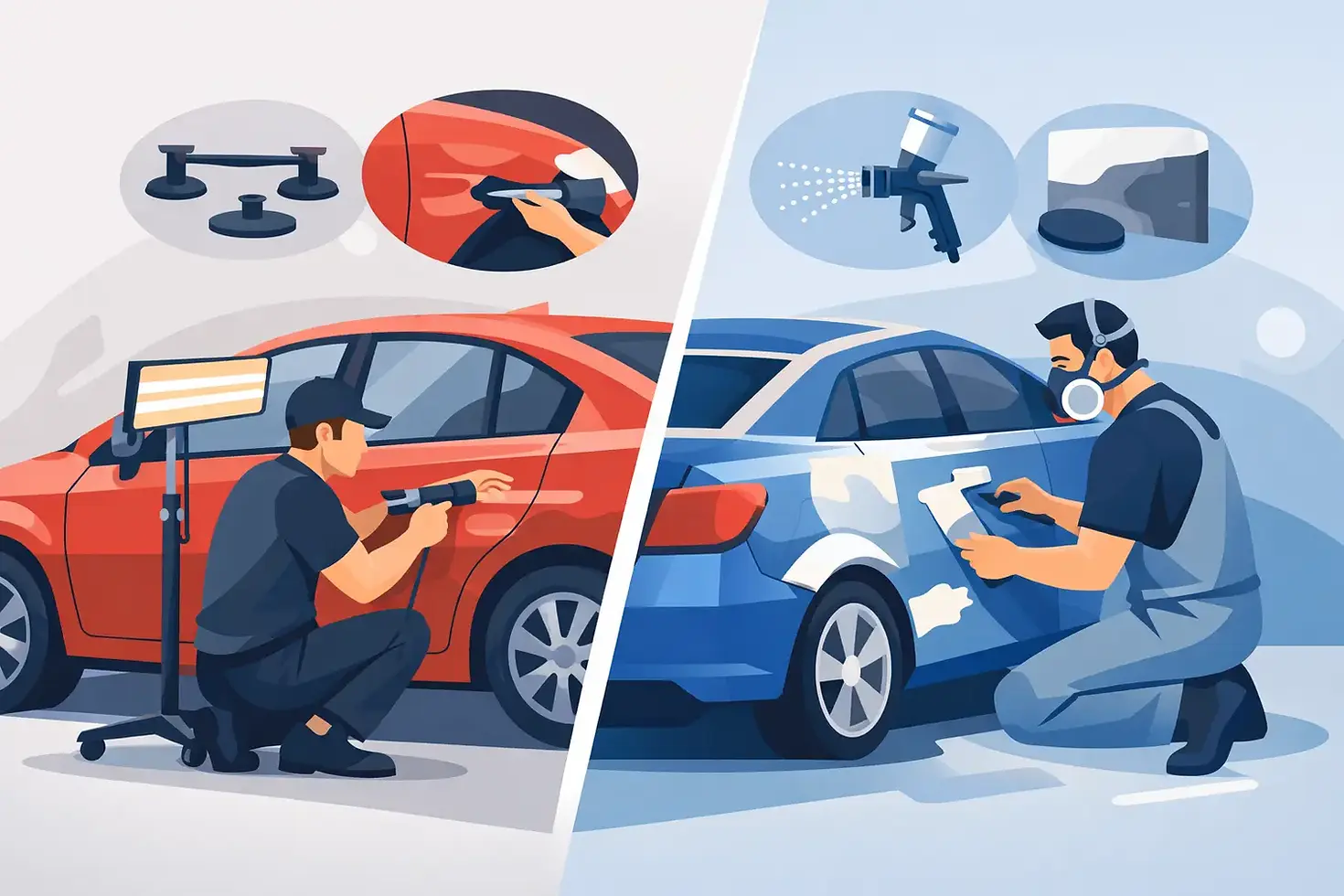
Paintless Dent Repair vs Bodywork
- 4 days ago
- 6 min read
A shopping cart rolls into your door in a parking lot, or a low-speed collision leaves a crease above the wheel well. The question comes up fast: paintless dent repair vs bodywork - which one is actually right for your vehicle? The answer depends on more than the size of the dent. Paint condition, panel access, metal stretch, impact location, and safety-related damage all matter if you want the repair done right.
For many drivers, paintless dent repair sounds like the obvious better option because it is faster and usually less invasive. Sometimes that is absolutely true. But there are also cases where traditional bodywork is the only repair method that restores the panel correctly, protects corrosion resistance, and brings the vehicle back to factory standards. Choosing the wrong process can leave visible flaws, weaken long-term durability, or create problems when the damage is more than cosmetic.
Paintless dent repair vs bodywork: what is the difference?
Paintless dent repair, often called PDR, is a specialized method used to reshape a damaged panel without sanding, filling, or repainting it. A trained technician accesses the back side of the panel when possible and uses precision tools to massage the metal back into position. In some situations, controlled glue-pulling techniques are also used from the exterior surface. The goal is to restore the panel while preserving the original factory finish.
Traditional bodywork takes a different path. If a dent cannot be fully corrected through metal manipulation alone, the damaged area may need to be pulled, reshaped, filled, sanded, primed, and refinished. That process is more involved, but it allows a shop to correct deeper deformation, sharp creases, paint damage, edge distortion, and collision-related structural issues that PDR cannot safely solve.
Neither method is automatically better in every case. The right choice depends on the kind of damage your vehicle has and what it takes to restore both appearance and function.
When paintless dent repair is the better repair
PDR works best when the paint surface is still intact and the metal has not been stretched beyond its ability to return to shape. This is common with minor parking lot dents, some hail damage, and soft impacts on broad, flexible sections of a panel. If the dent is shallow, the edges are smooth, and the technician can access the back side of the damaged area, paintless repair can produce an excellent result.
One of the biggest advantages is that the original finish stays in place. Factory paint is typically the most durable finish your vehicle will ever have, so preserving it has real value. PDR also usually reduces repair time because it avoids the full refinishing cycle. There is no need for body filler, primer, paint mixing, and curing when the damage qualifies for paintless correction.
For vehicle owners, that can mean less downtime, lower repair cost, and a cleaner outcome when the damage is truly minor. It is especially appealing on newer vehicles where keeping the original finish matters for appearance and resale.
Still, paintless repair is not magic. A dent can look small and still be a poor candidate if the impact created a hard line, damaged the panel edge, or disturbed the paint surface in a way that is not obvious until a technician inspects it under proper lighting.
When bodywork is the right call
Bodywork becomes necessary when the panel needs more than careful reshaping. If the paint is cracked, chipped, or broken, repainting is often required to seal and protect the surface. If the metal is sharply creased or stretched, PDR may improve the panel but not restore it to the level most drivers expect.
This is also true when damage reaches critical areas such as body lines, wheel openings, panel edges, or reinforced sections. Those areas are harder to manipulate cleanly because the metal is less forgiving. In collision repair, a visible dent may also be paired with hidden damage behind the panel. Mounting points, brackets, absorbers, sensors, and adjacent structure all need to be considered before anyone labels the repair cosmetic.
Traditional bodywork gives a certified repair facility more ways to correct that damage fully. The process may involve panel repair, part replacement, refinishing, and post-repair checks to confirm that the vehicle meets manufacturer standards where applicable. That matters because appearance is only part of the job. The repair also has to protect safety systems, corrosion resistance, and long-term durability.
The real deciding factors
The first factor is paint condition. If the finish is unbroken, PDR stays on the table. If the paint has failed, bodywork is usually required. Even a hairline crack can allow moisture intrusion over time, which is not something a quality repair should ignore.
The second factor is dent shape and depth. Broad, shallow dents are typically better PDR candidates than deep, pointed impacts. Sharp creases often mean the metal has been stressed too severely to return cleanly without conventional repair methods.
The third factor is location. A dent in the center of a door is very different from one near a panel edge or character line. The closer the damage is to a reinforced area, the more limited paintless techniques become.
The fourth factor is access. Some dents are in theory repairable with PDR, but there is no practical tool access behind the panel. In those cases, a shop has to evaluate whether glue-pulling is appropriate or whether bodywork will produce a more accurate result.
The last factor is whether the damage is truly isolated. If the vehicle was involved in a collision, even a light one, the panel damage may only be the visible part of the problem. A proper estimate should consider alignment of adjacent panels, sensor locations, fastener points, and any signs of deeper impact transfer.
Why the cheapest option is not always the right one
Drivers naturally want the simplest repair that solves the problem. That makes sense. But choosing PDR only because it costs less can backfire if the damage does not qualify. A dent that is forced through the wrong repair method may remain visibly distorted under sunlight, with ripples, high spots, or tension marks that were never fully corrected.
On the other side, not every dent needs full refinishing. Some shops may default to conventional bodywork when a skilled PDR assessment could preserve the original finish and reduce repair time. That is why accurate damage analysis matters so much. You want a recommendation based on repairability, not guesswork and not a one-size-fits-all process.
A trustworthy shop should explain why a panel qualifies for paintless repair, why it does not, or why a blended approach makes the most sense. In some cases, PDR can reduce the extent of bodywork before refinishing. That kind of measured decision-making usually leads to a better final result.
Paintless dent repair vs bodywork after an accident
After a collision, the comparison changes. Minor cosmetic dents from door dings or hail are one thing. Accident damage is another. Once impact forces involve bumpers, fenders, quarter panels, suspension angles, sensors, or structural alignment, the repair decision has to be made in a much broader context.
A dented panel after an accident may still need traditional bodywork even if the metal damage looks moderate. That is because collision repair is not only about making the outside look straight again. It is about restoring the vehicle to safe operating condition, confirming hidden damage, and following repair procedures that support OEM safety performance.
For drivers in Temple Hills and across the DC area, this is where certified repair experience matters. A family-owned shop like Innovation Auto Body Mechanics & Tires can evaluate whether the damage is a true cosmetic candidate for PDR or part of a larger repair plan that requires refinishing, structural checks, mechanical inspection, and insurance coordination.
What to ask before you approve a repair
Ask whether the paint is still fully intact, whether the metal has been stretched, and whether the dent sits on a body line or reinforced section. Ask if there is safe access behind the panel and whether the shop sees any signs of hidden collision damage. If traditional bodywork is recommended, ask why PDR would not meet the standard for a proper repair.
You should also ask how the final finish will be matched and what warranty stands behind the work. Confidence comes from process, not promises. The best repair plan is the one that fits the actual damage and protects your vehicle for the long run.
A good shop will not push one method for every customer. It will inspect the vehicle carefully, explain the trade-offs clearly, and recommend the repair that brings your car back as close as possible to factory condition. That is the standard worth looking for, especially when the damage seems small but the stakes are not.



Comments