.png)
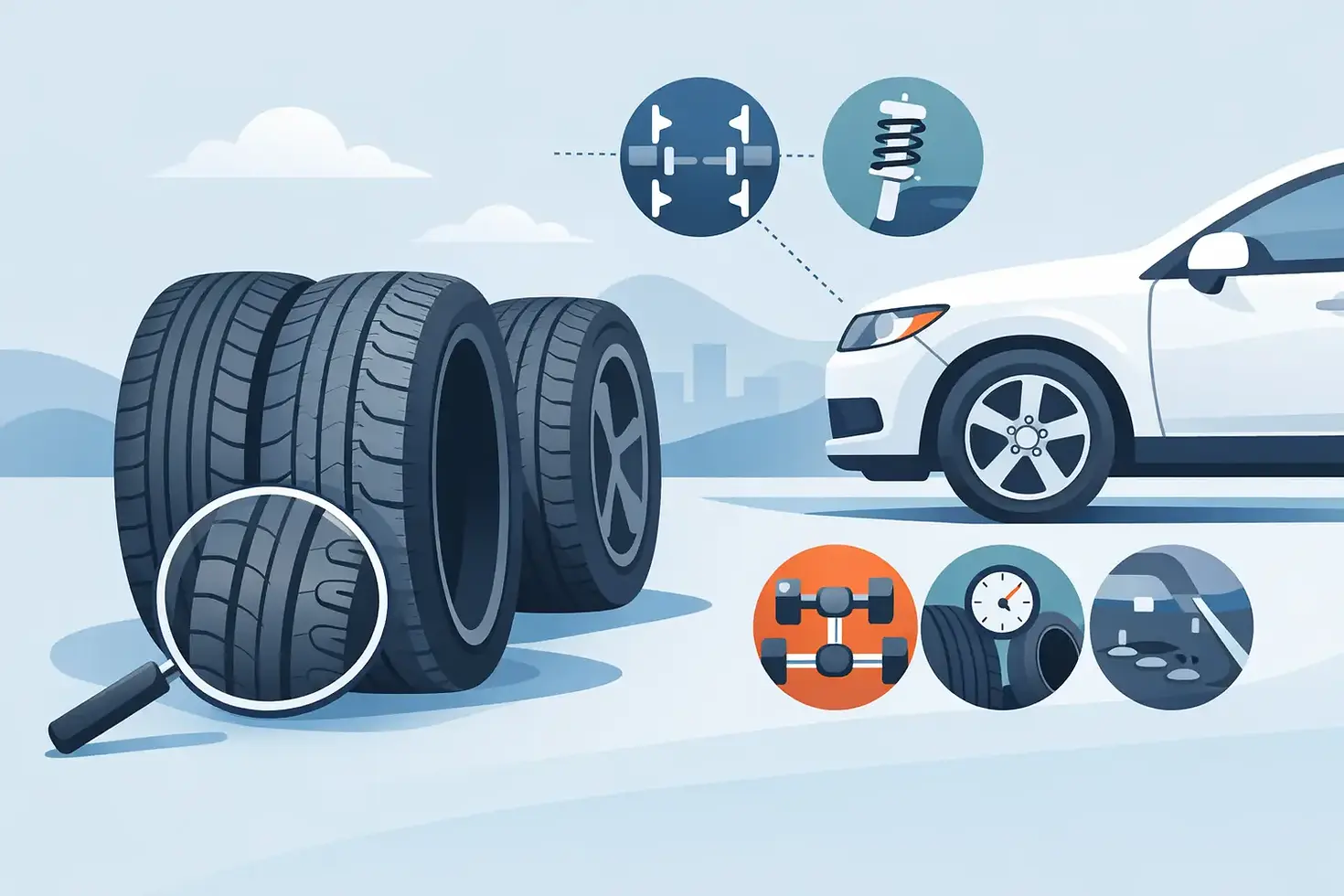
What Causes Uneven Tire Wear?
- Jun 30
- 6 min read
One tire looks nearly new at the center, another is bald on the inside edge, and now the steering feels slightly off on your morning commute. If you are wondering what causes uneven tire wear, the answer usually points to a problem deeper than the rubber itself. Tires wear in patterns, and those patterns often reveal issues with alignment, suspension geometry, inflation pressure, or worn steering components.
At a professional shop, uneven tread is not treated as a cosmetic concern. It is a safety and performance issue. Tire wear affects braking distance, wet-weather traction, ride stability, fuel efficiency, and how well your vehicle stays planted in a turn or emergency maneuver. When wear becomes irregular, the right response is not just replacing the tire. It is finding the source and correcting it to factory standards.
What causes uneven tire wear on a vehicle?
In most cases, uneven tire wear happens because the tire is not meeting the road evenly and consistently. That can be caused by improper wheel alignment, underinflation or overinflation, unbalanced tires, neglected tire rotations, damaged suspension parts, or impact-related issues after hitting a pothole or curb. Sometimes the cause is straightforward. In other cases, it is a combination of small problems that build over time.
A tire is designed to carry load across its full contact patch. When camber, toe, or caster angles move outside specification, or when a worn component allows extra movement in the suspension, part of the tread takes more abuse than the rest. The result is accelerated wear in specific areas, often before the driver notices a handling change.
Alignment problems are one of the most common causes
If you want the short answer to what causes uneven tire wear, alignment is near the top of the list. Modern vehicles rely on precise wheel angles to keep tread wear even and handling predictable. When those angles shift, the tire can begin scrubbing against the road instead of rolling cleanly.
Toe is a major factor. Too much toe-in or toe-out can feather the tread and wear tires quickly. Camber also matters. If the top of the wheel leans too far inward or outward, the tire may wear heavily on the inside or outside edge. Caster affects stability and steering return, and while it does not usually wear tires on its own as dramatically as toe or camber, it can contribute to broader handling concerns.
Misalignment does not always happen gradually. It can start after one hard pothole impact, curb strike, or collision. That matters in this region, where rough pavement, construction zones, and commuter traffic around Prince George's County and DC can be hard on wheels, tires, and suspension systems.
Signs alignment is behind the wear
You may notice the vehicle pulling to one side, a crooked steering wheel when driving straight, or faster wear on one edge of the tire. In some cases, there are no obvious symptoms until the tread is already compromised. That is why visual tire inspections and alignment checks are worth taking seriously, especially after road impacts.
Tire pressure changes wear more than many drivers realize
Inflation pressure directly affects how the tread contacts the road. Underinflated tires tend to wear more on the outer shoulders because the center of the tread is not carrying enough of the load. Overinflated tires often wear more in the center because the contact patch becomes too narrow.
Pressure-related wear can also hurt fuel economy and handling. An underinflated tire flexes more, runs hotter, and becomes more vulnerable to internal damage. An overinflated tire may feel firm, but it usually delivers less consistent traction and a harsher ride. Neither condition is ideal for tread life.
Temperature swings can make this worse. A tire that was close to correct pressure a month ago may not still be there now. That is why pressure should be checked regularly with a quality gauge, not guessed by appearance alone. A tire can look acceptable and still be several PSI off specification.
Suspension and steering wear can create hidden tire damage
Not every uneven wear problem starts with the alignment rack. Sometimes the alignment cannot hold because a component underneath the vehicle is worn or loose. Ball joints, tie rod ends, control arm bushings, struts, shocks, and wheel bearings all play a role in how consistently the tire meets the road.
When these parts wear out, the wheel can move in ways it should not. That movement may be slight at first, but it changes load distribution across the tread. You might feel vibration, looseness in the steering, clunking over bumps, or instability during braking. Or you may notice none of those things and only see the tire wear pattern later.
This is especially important after a collision or underbody impact. If structural or suspension geometry has changed, replacing tires without inspecting the supporting system can leave the root problem untouched. Certified diagnosis matters because the issue may involve more than a simple adjustment.
Poor tire balance and rotation habits also contribute
Unbalanced tires do not always create a visible pattern right away, but they can cause cupping or scalloping over time. This often feels like a vibration at certain speeds and can put extra stress on the suspension. Cupped tread blocks are not just noisy. They reduce ride quality and can compromise grip.
Skipped tire rotations are another common factor. Front and rear tires often wear differently because they carry different loads and do different work, especially on front-wheel-drive vehicles. If rotations are delayed too long, those differences become more pronounced. Once a tire develops a strong wear pattern, rotating it later may not fully correct the issue.
Rotation intervals depend on the vehicle, tire type, and driving conditions, but staying consistent matters more than trying to stretch every mile out of a set of tires.
Driving habits and road conditions matter too
Hard cornering, frequent heavy braking, aggressive acceleration, and repeated contact with potholes all speed up tire wear. Delivery drivers, rideshare drivers, and daily commuters often see this first because their vehicles spend more time under stress. Urban driving can be especially tough because of stop-and-go traffic, rough intersections, and road debris.
Load also plays a role. If a vehicle regularly carries more weight than normal, or if weight is distributed unevenly, tire wear can change. Trucks, SUVs, and family vehicles that are consistently loaded with passengers, tools, or cargo may need closer attention to tire pressure and suspension condition.
There is a trade-off here. Some wear is simply the result of real-world use. Not every pattern signals major mechanical failure. But when wear appears early, grows fast, or affects one tire much more than the others, it is time for a proper inspection.
Reading the wear pattern helps identify the cause
Different tread patterns tell different stories. Inside or outside edge wear often points to camber or toe problems. Center wear usually suggests overinflation. Both shoulder edges wearing faster than the middle often indicates underinflation. Feathering can signal toe misalignment, while cupping commonly points toward imbalance or worn suspension components.
Still, tread reading is not always a perfect one-to-one diagnosis. A vehicle can have both alignment issues and weak shocks. It can also have a damaged wheel, bent suspension part, or prior accident history affecting the result. That is why precision inspection matters more than assumptions.
When to have the vehicle inspected
If you see uneven tread, do not wait for the tire to become unsafe. Have the vehicle checked if it pulls, vibrates, wanders, steers inconsistently, or if the steering wheel is off-center. You should also schedule an inspection after a pothole strike, curb hit, or collision, even if the damage seems minor.
A proper evaluation should include more than a quick glance. The technician should inspect tread depth across the tire, confirm inflation, check balance history, evaluate suspension and steering components, and measure alignment angles against manufacturer specifications. If damage is found, the repair should be completed before new tires are installed whenever possible. That is the difference between a short-term fix and a repair done right.
At Innovation Auto Body Mechanics & Tires, that kind of precision matters because tire wear is often a symptom, not the whole problem. Protecting the customer means correcting the cause, not just replacing the part that shows the damage first.
How to prevent uneven tire wear
The best prevention plan is straightforward. Check tire pressure regularly, rotate tires on schedule, keep wheels balanced, and have alignment checked when handling changes or after any significant road impact. Just as important, do not ignore small suspension symptoms. A minor steering or ride issue can become expensive tire damage if it is left alone.
For drivers who depend on their vehicles every day, early inspection is usually the most cost-effective move. One alignment correction or suspension repair can save a full set of tires and restore the ride quality you have been missing without realizing it.
If your tread is wearing unevenly, your vehicle is telling you something specific. Listen early, have it measured accurately, and give the problem the kind of certified attention that protects both safety and long-term value.


Comments